By my count, it had been 254 days since the New York Rangers had won a hockey game, and after the first two games of the season, it felt even longer. Sigh of relief cut somewhat short, the Blueshirts are right back in action tonight, against the Flyers. Herein lie some things that I feel like I need to say about Arron Asham, followed by some other scattered thoughts on the three games that led to the Rangers' 1-2 start so far.
Arron Asham will be out again tonight, due to the same groin injury that kept him out last night. And that is awesome. Asham is a big dumb douchebag, which is a position I do not have to justify here. But let's talk about the only thing he's done for us so far: his home-opening-faceoff choreographed fight with Tanner "I'd make a pun about his last name and 'Glass Jaw' except that he kicked Asham's ass in the fight" Glass.
First of all, this fight was orchestrated by Penguins head coach and noted hat-wearer Dan Bylsma, who chose to start the game by putting out his second line - and then replacing his right wing with Tanner Glass for some reason. (Take notes, Bob Smizik: the home team gets to pick its lineup after the away team.) John Tortorella (he of the much less classy neckties) followed suit and replaced his scoring line's winger with Arron "seriously, this guy is the worst" Asham, and so the Rangers' home opener started with a meaningless fight.
The lockout made me wait 4 extra goddamn months to watch hockey in Madison Square Garden, and then Arron Asham made me wait yet another 5 minutes.
Here's the thing: there was absolutely nothing on the line in this fight, other than Asham's and Glass's jobs. This was stupid. Blame was placed, sort of?, at least by the coach a little, on the Rangers not pulling the requisite spark from the fight, but that is a stupid idea.
You don't magically rally around a dude getting his face punched, whether he's Brandon Prust or Arron Asham. Prust's fights rallied the team because they happened when they fucking mattered at all. I think Scotty Hockey put it best: some good times to fight in an NHL game might be when you go down by 2 late in the first period on your home opener, or when your team comes out flat in the second regardless, or when deep in garbage time your skill rookie gets flattened at the blue line and doesn't get back up. Those are good examples of when you might want to fight in an NHL game, all of which fucking happened that night. Instead, Asham got his face punched by Tanner Glass for a minute or two before the hockey game started, and -- go figure! -- it didn't have much effect on the game!
Also: in losing Asham last night, we moved Bickel up to forward, and brought Eminger back in on defense. That means that the only things that changed were our fourth line and our bottom two D-pairs. I want to be explicit here. We went from:
Rupp - Halpern - Asham
Staal / Stralman
Bickel / Del Zotto
to:
Rupp - Halpern - Bickel
Staal / Del Zotto
Eminger / Stralman
Look at those two lineups. The one without Asham is just plain better! We keep Bickel in the lineup to be big for 4 minutes a game, and our defensive pairs get way more reliable (not in the least by moving Del Zotto up to where Staal can cover for him). Everything looks better without this guy!
So, here's to you, Arron Asham's groin. May you stay minorly injured for the next 17 months or so.
-------------------------
In non-groin-related news, how excited am I about Rick Nash? Long-time regulars to this space (a chiefly fictional entity) will recall that I have been crushing on Nash for years. Along with a small handful of others (Dustin Byfuglien, Brooks Orpik), he's a guy I've dreamed of seeing in Broadway Blue for a long-ass time. But, like, for some reason, my dream came true on this one, and holy sweet Goddamn, he is so good at hockey, especially when he's on a real team. If this were a 3-game season, he'd undoubtedly be team MVP (and it would be a very disappointing season). Defensively responsible, strong on the puck... seriously, everything you want in a forward. Actually, the more I think about him, the more this news might be groin-related after all.
That was an erection joke.
-------------------------
After a win in which Gaborik, Richards, Stepan, Callahan, and Nash averaged 21:28 of ice time each, and no other forward touched 15:30, Coach Tortorella doubled down on his one-line-to-rule-them-all strategy, explaining: "Quite honestly, I'm not comfortable playing a four-line rotation. I don't think guys have played well enough for me to play a four-line rotation comfortably, because we need to win."
And the worst part is: he's right. Hell, I'm not even comfortable rolling three. Beyond the big three marquee names (who have at least pulled their weight and at most been Rick Nash), there hasn't been much from anyone. We all expected Kreider's play to take a significant dive (or, if you didn't, you damn well should have). But all the other second-and-third-liners really need to step up. I understand that Dubinsky and Anisimov are gone (for good reason), and Prust and Fedotenko are gone (possibly for less good reason), but this team still has Ryan Callahan, Brian Boyle, Carl Hagelin, and Derek Stepan, all of whom need to get rolling.
But there's reason to believe they will. This season started after 5 days of camp with no pre-season. The style the Rangers play -- gritty, in-your-face, shot-blocking, defensive -- takes a longer time to get rolling. That's why we've seen so many scores like 5 and 6 already. As the season starts to settle in, expect overall scores to drop some - and with that, expect the Rangers' defense and middle-liners to get back into their groove. And, by the way, that will include Taylor Pyatt, whom you should start preparing to like, if you don't already. Remember that.
Frankly, it can't come soon enough, otherwise, under Torts, those top three guys are gonna get real tired.
Thursday, January 24, 2013

Tuesday, January 15, 2013
Michael Del Zotto is making too much money
I don't actually care *that* much, because Matt Gilroy probably isn't making enough, which kinda balances out? We signed DZ to a 2-year deal at $2.55 million per. For that price, 2 years is exactly the right length - it's up the year this team gets completely dismantled anyway (because everyone else's contract is also up), so it'll be a very good time to reassess. If Del Zotto has another two seasons like last year, he'll be much more exposed for it, and he'll be up for a pay cut or pink slip. But the money is higher than I'd have liked.
I wrote last week that I'd want to pay him around $2 million, and I stand behind that. For reference points, I'd look at Anton Stralman, making $1.7 million, and Dan Girardi, making $3.325. I think Del Zotto is closer to a Stralman than he is to a Girardi, as he's often an on-ice liability, despite his point totals. But as you know, I don't rate defensemen on their ability to score goals.
Anyway, overpaying him by $550,000 a year is not bothering me a lot today because we also signed Matt Gilroy to a one-year, $650,000 deal. And if I'd heard that deal was a million instead, I wouldn't have blinked. Gilroy's got a very good offensive upside, if not quite Del Zotto's, and he backs it up by being a little bigger, and a little bit older and more responsible. Right now, I'd put Gilroy on the ice for a given shift before I put Del Zotto out there. So, to delude myself into happiness, I will simplify and say that we signed Del Zotto and Gilroy this week, for a total of $3.2 million. I can get behind that.
Those of you who have been paying attention will recall that that leaves us with $2,141,666 or cap space, with everyone signed. That's not a ton of wiggle room, but it's a bit. And remember that we've got an additional $1.25 million of salary we can use to replace Sauer and $1.25 million of bonus overage we could borrow from next season. So, cap-wise, things are not so bad this season at all.
Is it Saturday yet?
I wrote last week that I'd want to pay him around $2 million, and I stand behind that. For reference points, I'd look at Anton Stralman, making $1.7 million, and Dan Girardi, making $3.325. I think Del Zotto is closer to a Stralman than he is to a Girardi, as he's often an on-ice liability, despite his point totals. But as you know, I don't rate defensemen on their ability to score goals.
Anyway, overpaying him by $550,000 a year is not bothering me a lot today because we also signed Matt Gilroy to a one-year, $650,000 deal. And if I'd heard that deal was a million instead, I wouldn't have blinked. Gilroy's got a very good offensive upside, if not quite Del Zotto's, and he backs it up by being a little bigger, and a little bit older and more responsible. Right now, I'd put Gilroy on the ice for a given shift before I put Del Zotto out there. So, to delude myself into happiness, I will simplify and say that we signed Del Zotto and Gilroy this week, for a total of $3.2 million. I can get behind that.
Those of you who have been paying attention will recall that that leaves us with $2,141,666 or cap space, with everyone signed. That's not a ton of wiggle room, but it's a bit. And remember that we've got an additional $1.25 million of salary we can use to replace Sauer and $1.25 million of bonus overage we could borrow from next season. So, cap-wise, things are not so bad this season at all.
Is it Saturday yet?
Thursday, January 10, 2013
Salary Cap '12-'13
OK, so let's crunch some numbers on this season, for the Rangers. I've been wanting to do this for about 4 months, so indulge me. You might even learn something.
First of all, to make the math easy, I'm going to refer to every number as if this were a full season. All cap hits, and the cap, are pro-rated to the shortened length of this season, but multiplying every number here by the same percentage won't change the math any, and it will make things more complicated. So fuck that.
So, this season's cap is $70.2 million, which if I'm not mistaken is exactly what last season's cap was. It's hard to remember, as last season feels like it was about a decade ago. As you'd expect, the Rangers already have most of their roster locked down under contract. Where's that money going?
Returning Forwards (8 for $24,716,667): Gaborik (7.5); Richards (6.666667); Callahan (4.275); Boyle (1.7); Rupp (1.5); Kreider (1.325); Stepan (0.875); Hagelin (0.875)
New Forwards (5 for $11,650,000): Rick Nash (7.8); Taylor Pyatt (1.55); Arron Asham (fuck that guy) (1); Jeff Halpern (0.7); Micheal Haley (0.6)
Returning Defensemen (6 for $11,800,000): Staal (3.975); Girardi (3.325); Stralman (1.7); McDonagh (1.3); Eminger (0.75); Bickel (0.75)
Returning Goalies (2 for $8,175,000): Lundqvist (6.875); Biron (1.3)
That's a total of $56,341,667 on actual roster players, leaving $13,858,333 under the cap. Plenty of room. But there's some more to deal with.
First, as you already know, we have to pay off the final year of Chris Drury's buyout, for $1,666,667. Then, there's the new rule - the Redden Rule - that prevents salary burial in the AHL. The rule is that any one-way NHL contracts, even if the player is playing in the AHL and not on your NHL roster, still count against the cap. How much they count is still not publicly known, but it appears to be everything over the first $900,000 of the cap hit. That's the figure CapGeek uses, anyway. And it's a figure I believe. Redden's full NHL cap hit would be $6.5 million, so he'll be costing the Rangers $5.6 million under the cap this year, to play in Connecticut.
And then, there's the whole Michael Sauer thing. You should stop, in case you still are, asking whether or not Sauer will come back to the Rangers this season, and start asking if he's going to be healthy enough for a normal life - things are apparently really bad. With that said, we're here to talk about the cap, and Sauer is still under contract to the Rangers this season, for a hit of $1.25 million.
Drury, Redden, and Sauer add up to $8,516,667 for non-roster players, taking the Rangers' space down to $5,341,666. And then there are new contracts forthcoming. You'll note that the above player lists did not include noted favorite defenseman of this blog, Michael Del Zotto. He's still in contract talks with the Rangers (talks in which he has no leverage, as a restricted free agent not eligible for arbitration), and he reportedly wants a multi-year deal at over $3 million a year.
For reference, the New York Rangers pay Dan Girardi $3.325 million per year.
On what fucking planet is Michael Del Zotto worth what Dan Girardi is worth?
My paragraphs are becoming one sentence long to show how shocked I am by this idea.
Is it working?
Michael Del Zotto, your qualifying offer based on last season's salary should be $918,750 - maybe less, depending on a signing bonus. Least season, you were the least responsible defender on the team more nights than anyone else on the squad except Stu Bickel, who makes $750,000 to play 8 minutes a game and be 6'4". Where the shit-balls do you get off asking for Dan Girardi money, you deluded sociopath?
At any rate, $5,341,666 should be enough space to re-sign Del Zotto and sign camp invitee, once and future Ranger Matt Gilroy to a reasonable contract (~2 for DZ, ~1.5 for Gilroy?). But it doesn't leave the team very much wiggle room to make moves down the line.
But: There is a little more room than I presented here. First of all, Sauer will of course be on Long-Term Injured Reserve. This allows the Rangers to call up "replacement players" whose salaries add up to no more than Sauer's salary this season (which is also his cap hit, $1.25 million). So, for example, they could call Arron Asham a replacement for Sauer (which, frankly, would be textbook "adding insult to injury") because Asham's million-dollar salary is less than Sauer's, which means that, while Sauer still counts against the cap, Asham wouldn't. That would save the Rangers a million dollars under the cap.
Finally, there's the performance bonus cushion. Some of the above cap hits include performance bonuses - money that is only paid out if that player accomplishes some thing this season (number of games played, number of points, that kind of thing). Any potential bonuses count against the cap, until the accomplishments are no longer achievable. However, teams are permitted to go over the cap by those bonuses in the meanwhile (up to 7.5% of the total cap), and then if they end up getting paid out, that amount is docked from next year's cap. So, it's a last resort, as it's borrowing against the future, but it is technically some wiggle room.
The numbers above include, in performance bonuses, $637,500 for Kreider, $425,000 for McDonagh, and $187,500 for Hagelin, for a total of $1.25 million that the Rangers could theoretically borrow against next season (or, if things go badly for those players, not pay out at all).
This all means that, to sign Del Zotto and possibly Gilroy, and for future wiggle room, the Rangers have $5,341,666 free, plus about $2.5 million by which they can go over (1.25 for Sauer's replacement, 1.25 for performance bonuses). And now you know.
First of all, to make the math easy, I'm going to refer to every number as if this were a full season. All cap hits, and the cap, are pro-rated to the shortened length of this season, but multiplying every number here by the same percentage won't change the math any, and it will make things more complicated. So fuck that.
So, this season's cap is $70.2 million, which if I'm not mistaken is exactly what last season's cap was. It's hard to remember, as last season feels like it was about a decade ago. As you'd expect, the Rangers already have most of their roster locked down under contract. Where's that money going?
Returning Forwards (8 for $24,716,667): Gaborik (7.5); Richards (6.666667); Callahan (4.275); Boyle (1.7); Rupp (1.5); Kreider (1.325); Stepan (0.875); Hagelin (0.875)
New Forwards (5 for $11,650,000): Rick Nash (7.8); Taylor Pyatt (1.55); Arron Asham (fuck that guy) (1); Jeff Halpern (0.7); Micheal Haley (0.6)
Returning Defensemen (6 for $11,800,000): Staal (3.975); Girardi (3.325); Stralman (1.7); McDonagh (1.3); Eminger (0.75); Bickel (0.75)
Returning Goalies (2 for $8,175,000): Lundqvist (6.875); Biron (1.3)
That's a total of $56,341,667 on actual roster players, leaving $13,858,333 under the cap. Plenty of room. But there's some more to deal with.
First, as you already know, we have to pay off the final year of Chris Drury's buyout, for $1,666,667. Then, there's the new rule - the Redden Rule - that prevents salary burial in the AHL. The rule is that any one-way NHL contracts, even if the player is playing in the AHL and not on your NHL roster, still count against the cap. How much they count is still not publicly known, but it appears to be everything over the first $900,000 of the cap hit. That's the figure CapGeek uses, anyway. And it's a figure I believe. Redden's full NHL cap hit would be $6.5 million, so he'll be costing the Rangers $5.6 million under the cap this year, to play in Connecticut.
And then, there's the whole Michael Sauer thing. You should stop, in case you still are, asking whether or not Sauer will come back to the Rangers this season, and start asking if he's going to be healthy enough for a normal life - things are apparently really bad. With that said, we're here to talk about the cap, and Sauer is still under contract to the Rangers this season, for a hit of $1.25 million.
Drury, Redden, and Sauer add up to $8,516,667 for non-roster players, taking the Rangers' space down to $5,341,666. And then there are new contracts forthcoming. You'll note that the above player lists did not include noted favorite defenseman of this blog, Michael Del Zotto. He's still in contract talks with the Rangers (talks in which he has no leverage, as a restricted free agent not eligible for arbitration), and he reportedly wants a multi-year deal at over $3 million a year.
For reference, the New York Rangers pay Dan Girardi $3.325 million per year.
On what fucking planet is Michael Del Zotto worth what Dan Girardi is worth?
My paragraphs are becoming one sentence long to show how shocked I am by this idea.
Is it working?
Michael Del Zotto, your qualifying offer based on last season's salary should be $918,750 - maybe less, depending on a signing bonus. Least season, you were the least responsible defender on the team more nights than anyone else on the squad except Stu Bickel, who makes $750,000 to play 8 minutes a game and be 6'4". Where the shit-balls do you get off asking for Dan Girardi money, you deluded sociopath?
At any rate, $5,341,666 should be enough space to re-sign Del Zotto and sign camp invitee, once and future Ranger Matt Gilroy to a reasonable contract (~2 for DZ, ~1.5 for Gilroy?). But it doesn't leave the team very much wiggle room to make moves down the line.
But: There is a little more room than I presented here. First of all, Sauer will of course be on Long-Term Injured Reserve. This allows the Rangers to call up "replacement players" whose salaries add up to no more than Sauer's salary this season (which is also his cap hit, $1.25 million). So, for example, they could call Arron Asham a replacement for Sauer (which, frankly, would be textbook "adding insult to injury") because Asham's million-dollar salary is less than Sauer's, which means that, while Sauer still counts against the cap, Asham wouldn't. That would save the Rangers a million dollars under the cap.
Finally, there's the performance bonus cushion. Some of the above cap hits include performance bonuses - money that is only paid out if that player accomplishes some thing this season (number of games played, number of points, that kind of thing). Any potential bonuses count against the cap, until the accomplishments are no longer achievable. However, teams are permitted to go over the cap by those bonuses in the meanwhile (up to 7.5% of the total cap), and then if they end up getting paid out, that amount is docked from next year's cap. So, it's a last resort, as it's borrowing against the future, but it is technically some wiggle room.
The numbers above include, in performance bonuses, $637,500 for Kreider, $425,000 for McDonagh, and $187,500 for Hagelin, for a total of $1.25 million that the Rangers could theoretically borrow against next season (or, if things go badly for those players, not pay out at all).
This all means that, to sign Del Zotto and possibly Gilroy, and for future wiggle room, the Rangers have $5,341,666 free, plus about $2.5 million by which they can go over (1.25 for Sauer's replacement, 1.25 for performance bonuses). And now you know.
Wednesday, January 9, 2013
Some short shots
Man, hockey is back with a vengeance, people. Here are some things you should know about.
1) By today, every Ranger has made it to practice. Note that these practices are self-organized, as the coaches can't communicate with the players until the CBA is officially approved. But they're all skating together now. This includes, believe it or not, Matt Gilroy, who is back on a tryout. I'd like to see that work out. I'd also like to see his presence drive down Del Zotto's contract value - hearing he's asking for over $3 million for multiple years. Silly.
2) According to the Twitters, the Rangers have finally done away with the last vestiges of that awful Lady Liberty logo that my Dad likes for some reason - it was still on the practice jerseys, but it won't be anymore. Sorry, Dad, but I'm glad to see it go.
3) Still no answers on the Redden cap hit, but it's looking likely that yes, the Rangers will have to deal with that hit this season with no recourse. How much of it, though, I still don't understand. He's got a $5 million salary with a $6.5 million cap hit this season and next. Capgeek has his hit listed at $5.6 million, and I have no idea where that number comes from or how accurate it is. I'll look at the full cap situation in detail one day, if I can get accurate information ever.
4) On Sunday morning, at 6:49 AM (less than 2 hours after the informal agreement between Bettman and Fehr that effectively ended the lockout), apparently Henrik Lundqvist texted 10 other Rangers who were still in New York, inviting them out to practice. Only 2 (Del Zotto and Eminger) showed up, but still - this guy is really something.
5) What the hell, people? The Leafs fired Brian Burke today. Today. Not 6 months ago, not in a few months depending on how things go. Today. At the conclusion of his role in CBA negotiations, on the cusp of a shortened season in which I imagine Toronto is probably already scrambling to figure out a thing or two. I have a lot of trouble buying this. I like Burke, if not as much as some of my friends do, and there's no denying he's a powerful voice for hockey as a whole, if not necessarily the right answer for the Maple Leafs right now. But regardless, a firing right now doesn't make any sense to me at all. Related: where will Roberto Luongo be soon?
1) By today, every Ranger has made it to practice. Note that these practices are self-organized, as the coaches can't communicate with the players until the CBA is officially approved. But they're all skating together now. This includes, believe it or not, Matt Gilroy, who is back on a tryout. I'd like to see that work out. I'd also like to see his presence drive down Del Zotto's contract value - hearing he's asking for over $3 million for multiple years. Silly.
2) According to the Twitters, the Rangers have finally done away with the last vestiges of that awful Lady Liberty logo that my Dad likes for some reason - it was still on the practice jerseys, but it won't be anymore. Sorry, Dad, but I'm glad to see it go.
3) Still no answers on the Redden cap hit, but it's looking likely that yes, the Rangers will have to deal with that hit this season with no recourse. How much of it, though, I still don't understand. He's got a $5 million salary with a $6.5 million cap hit this season and next. Capgeek has his hit listed at $5.6 million, and I have no idea where that number comes from or how accurate it is. I'll look at the full cap situation in detail one day, if I can get accurate information ever.
4) On Sunday morning, at 6:49 AM (less than 2 hours after the informal agreement between Bettman and Fehr that effectively ended the lockout), apparently Henrik Lundqvist texted 10 other Rangers who were still in New York, inviting them out to practice. Only 2 (Del Zotto and Eminger) showed up, but still - this guy is really something.
5) What the hell, people? The Leafs fired Brian Burke today. Today. Not 6 months ago, not in a few months depending on how things go. Today. At the conclusion of his role in CBA negotiations, on the cusp of a shortened season in which I imagine Toronto is probably already scrambling to figure out a thing or two. I have a lot of trouble buying this. I like Burke, if not as much as some of my friends do, and there's no denying he's a powerful voice for hockey as a whole, if not necessarily the right answer for the Maple Leafs right now. But regardless, a firing right now doesn't make any sense to me at all. Related: where will Roberto Luongo be soon?
Tuesday, January 8, 2013
Questions Jim Cerny wants to answer
Jim Cerny hosted a live chat on Blueshirts United this afternoon, to answer fan questions about the upcoming season. Dave Maloney dropped in for a while. It seemed to be a pretty good forum to ask my somewhat concerning 6.5-million-dollar question. So I submitted: "If the Redden Rule (no AHL salary burial) is in effect for this season, but teams don't get compliance buyouts until next season, are the Rangers stuck with Redden's $6.5 million cap hit for this year?"
Unfortunately, either Cerny or whatever moderator picks questions for him wasn't interested in addressing this question, or my follow-up half an hour later: "Jim, sorry to repeat an unanswered question, but can you explain the Redden cap situation? Does full AHL salary count against cap, or only partial? And does it count this season even though Rangers can't use compliance buyout until next?" So, I have no answers for you. Instead, I am forced to provide a treasury of the questions Jim Cerny did answer this afternoon, while he was not answering my question about the Rangers' salary cap situation.
So, if you want Jim Cerny's answers to any of those hard-hitting, fact-based, relevant questions, they're available.
Unfortunately, either Cerny or whatever moderator picks questions for him wasn't interested in addressing this question, or my follow-up half an hour later: "Jim, sorry to repeat an unanswered question, but can you explain the Redden cap situation? Does full AHL salary count against cap, or only partial? And does it count this season even though Rangers can't use compliance buyout until next?" So, I have no answers for you. Instead, I am forced to provide a treasury of the questions Jim Cerny did answer this afternoon, while he was not answering my question about the Rangers' salary cap situation.
- Dave, when is Ron Duguay going to get a hair cut?
- Which Ranger will lead the team in goals this season?
- It would be nice to see Rupper hammer some guys like he used to do against the Rangers!
- Even though he is new to the team, do you give Nash a letter on his sweater out of respect?
- hey jim what do think the rangers chances of winning the cup
- Hey Jim, are Sam Rosen and Joe Micheletti ready for this season?
- Hi Jim. The Rangers, after many years have finally put a team together that is not simply playing the game of hockey but rather play for each other. Who are the people most deserving the credit for that ? (Note: this one's response started with "Wow, great question, really a good one.")
- Jim: there was a rumor that Leetch might be brought in as a PP coach. Any truth to that?
- Hello Jim :) when do the camp start?
- Will the rangers come out on top in the conference this season?
So, if you want Jim Cerny's answers to any of those hard-hitting, fact-based, relevant questions, they're available.
One question and one brilliant thing
So, the vast majority of reports about these compliance buyouts I talked about yesterday say that each team can use up to two, used in some combination of the 2013 offseason and the 2014 offseason. Most of these reports imply, or outright state, that the buyouts cannot be used right now, in preparation for this shortened 2012-'13 season. However, it seems obvious that compliance with all the rules of the new CBA, including the Redden Rule, would be in place immediately.
So, my question is this: are the Rangers screwed cap-wise this year? Does Wade Redden's AHL value of $6.5 million (pro-rated) count against the cap for this abbreviated season, with the Rangers having no buyout recourse until next season? If so, that would mean that there's no option but to have $6.5 million of this season's cap tied up in Wade Redden. That's not the best.
Meanwhile, in awesome news, a Vancouver-based women's hockey team that calls itself the Ice-O-Topes apparently releases an annual pinup calendar for charity. That's not the awesome part yet. The awesome part is that they've decided, this year, to recreate "classic hockey moments" in their photos. The first photo shown in the article? Miss May, recreating the classic hockey moment "Mike Milbury Beats a Fan with His Own Shoe." That is awesome.
So, my question is this: are the Rangers screwed cap-wise this year? Does Wade Redden's AHL value of $6.5 million (pro-rated) count against the cap for this abbreviated season, with the Rangers having no buyout recourse until next season? If so, that would mean that there's no option but to have $6.5 million of this season's cap tied up in Wade Redden. That's not the best.
Meanwhile, in awesome news, a Vancouver-based women's hockey team that calls itself the Ice-O-Topes apparently releases an annual pinup calendar for charity. That's not the awesome part yet. The awesome part is that they've decided, this year, to recreate "classic hockey moments" in their photos. The first photo shown in the article? Miss May, recreating the classic hockey moment "Mike Milbury Beats a Fan with His Own Shoe." That is awesome.
Monday, January 7, 2013
Update: NHLPA vote
Looks like the NHLPA vote on the new CBA will not be complete until Saturday night. That would mean the absolute earliest training camps could start would be Sunday, more likely Monday. Which is a 5-day camp if the season starts the 19th. Not awesome. Sure would be nice, given that the NHL is voting in 2 days, if the NHLPA could get its shit together and vote that early as well - it'd almost double the length of training camp if they did. Longer training camp = less injury.
But hey, what stake does the NHL players' union have in NHL player safety?
But hey, what stake does the NHL players' union have in NHL player safety?
We're back, baby!
And the drums did sound, and the trumpets were heard on high, and lo, the hockey was returned to us, and it was very, very good.
As it was supposed to be, a deal was cut just in time to save a partial season, a deal that probably could have been cut months ago. But at least there won't be another blank space on the Cup. Plenty of fans are fed up and claim they won't come back, and good for them. The rest of us knew this whole time that we didn't have a choice. It's an abusive relationship: I know the NHL is going to keep doing this to us, and I know it's wrong and unacceptable, but it remains my best option for watching a highly competitive hockey league, in spite of all its abuse, so I choose to knowingly take it.
A name you should hear, in case you haven't, is that of federal mediator Scot Beckenbaugh, who spent all day Friday running back and forth between the two separate locations where the NHL and NHLPA were meeting, before spending all of Saturday bringing them together. Without him, it seems, a deal may not have gotten done. If you ever meet a man named Scot Beckenbaugh, buy him a beer.
As for whether or not the NHL and NHLPA have done irreparable damage to the game, I think Ron MacLean put it best yesterday: "A lot of Picasso's great paintings have been owned by crummy owners, but they remained Picassos."
So, time is short. Let's get down to brass tacks. This weekend (Sunday around 5:30 AM), the NHL and NHLPA tentatively agreed to a CBA proposal for a 2012-'13 hockey season. That proposal is currently being drafted into an official CBA, which will be voted on for approval by each party. The NHL's vote is scheduled for Wednesday, and I don't know when the PA votes (but it will also be this week). Once that passes, the season will officially be on, coaching staffs will be officially allowed to talk to players, etc.
Camps are therefore expected to start sometime in the Friday-to-Monday period and last about a week, with the first game of the season being, most likely, January 19. That should allow for a 48-game, inter-conference-only season. Let's see. Twice per intra-division opponent is 20 games, and 7 times per inter-division opponent is 28. That sounds about right to me. So expect to see our Atlantic Division opponents an extra time this year, even though the season itself is shorter.
The CBA's term is 10 years, with a mutual opt-out at year 8. So that means that we have until 2020 before this bullshit happens again. Which it will. A lot was worked out in these negotiations, some of which, like pensions, was very important to one party or the other, but is not at all interesting to us, as fans. Also, of course, the whole thing has not been released yet. But here are some of the main takeaways that we do care about.
(Grain of Salt Warning: Please note that all of these details are based on various second- and third-hand reports all over the Internet, and I have not confirmed and cannot confirm any of them until the new CBA is actually ratified and subsequently released to the public.) With that said, here's what I think we know so far.
The salary cap for this season will remain exactly where it was last season (pro-rated to the shortened length of the season), $70.2 million. It will be lowered for the 2013-'14 season, down to $64.3 million, and will then grow steadily from there. However, a new rule (colloquially, and appropriately, "The Redden Rule") prevents cap circumvention through salary burial in the AHL. Any players on one-way NHL contracts, even those in the AHL, will count against the cap (minus some nominal amount, like the first $250,000 or something). The salary floor will remain at (pro-rated) $44 million for each seasons.
To help comply with the new rules, each team will be allocated a total of two compliance buyouts that must be used within the next two seasons. These buyouts will follow the same monetary rules as other buyouts, except that none of them will count against the cap. Expect Redden's contract to be bought out almost as quickly as Scott Gomez's is.
Finally, some new contract rules were put in place to combat the Kovaltract. No new contract may be any longer than 7 years - or 8, if the player is re-signing with his own team. That's still a couple of years longer than I'd have liked, but it's a start. Additionally, no contract may vary from one year to the next by more than 35%, and, most restrictively, no single year of a contract may be worth any less than 50% of the contract's most expensive year.
That's all I've got for now - I'll look more into the Rangers' situation specifically soon, when there's an actual CBA to base it on. Right now it's all hearsay, so I'm not diving too deep.
HOLY SHIT HOCKEY IS BACK AND I AM EXACTLY AS EXCITED AS I EXPECTED TO BE.
That is all.
As it was supposed to be, a deal was cut just in time to save a partial season, a deal that probably could have been cut months ago. But at least there won't be another blank space on the Cup. Plenty of fans are fed up and claim they won't come back, and good for them. The rest of us knew this whole time that we didn't have a choice. It's an abusive relationship: I know the NHL is going to keep doing this to us, and I know it's wrong and unacceptable, but it remains my best option for watching a highly competitive hockey league, in spite of all its abuse, so I choose to knowingly take it.
A name you should hear, in case you haven't, is that of federal mediator Scot Beckenbaugh, who spent all day Friday running back and forth between the two separate locations where the NHL and NHLPA were meeting, before spending all of Saturday bringing them together. Without him, it seems, a deal may not have gotten done. If you ever meet a man named Scot Beckenbaugh, buy him a beer.
As for whether or not the NHL and NHLPA have done irreparable damage to the game, I think Ron MacLean put it best yesterday: "A lot of Picasso's great paintings have been owned by crummy owners, but they remained Picassos."
So, time is short. Let's get down to brass tacks. This weekend (Sunday around 5:30 AM), the NHL and NHLPA tentatively agreed to a CBA proposal for a 2012-'13 hockey season. That proposal is currently being drafted into an official CBA, which will be voted on for approval by each party. The NHL's vote is scheduled for Wednesday, and I don't know when the PA votes (but it will also be this week). Once that passes, the season will officially be on, coaching staffs will be officially allowed to talk to players, etc.
Camps are therefore expected to start sometime in the Friday-to-Monday period and last about a week, with the first game of the season being, most likely, January 19. That should allow for a 48-game, inter-conference-only season. Let's see. Twice per intra-division opponent is 20 games, and 7 times per inter-division opponent is 28. That sounds about right to me. So expect to see our Atlantic Division opponents an extra time this year, even though the season itself is shorter.
The CBA's term is 10 years, with a mutual opt-out at year 8. So that means that we have until 2020 before this bullshit happens again. Which it will. A lot was worked out in these negotiations, some of which, like pensions, was very important to one party or the other, but is not at all interesting to us, as fans. Also, of course, the whole thing has not been released yet. But here are some of the main takeaways that we do care about.
(Grain of Salt Warning: Please note that all of these details are based on various second- and third-hand reports all over the Internet, and I have not confirmed and cannot confirm any of them until the new CBA is actually ratified and subsequently released to the public.) With that said, here's what I think we know so far.
The salary cap for this season will remain exactly where it was last season (pro-rated to the shortened length of the season), $70.2 million. It will be lowered for the 2013-'14 season, down to $64.3 million, and will then grow steadily from there. However, a new rule (colloquially, and appropriately, "The Redden Rule") prevents cap circumvention through salary burial in the AHL. Any players on one-way NHL contracts, even those in the AHL, will count against the cap (minus some nominal amount, like the first $250,000 or something). The salary floor will remain at (pro-rated) $44 million for each seasons.
To help comply with the new rules, each team will be allocated a total of two compliance buyouts that must be used within the next two seasons. These buyouts will follow the same monetary rules as other buyouts, except that none of them will count against the cap. Expect Redden's contract to be bought out almost as quickly as Scott Gomez's is.
Finally, some new contract rules were put in place to combat the Kovaltract. No new contract may be any longer than 7 years - or 8, if the player is re-signing with his own team. That's still a couple of years longer than I'd have liked, but it's a start. Additionally, no contract may vary from one year to the next by more than 35%, and, most restrictively, no single year of a contract may be worth any less than 50% of the contract's most expensive year.
That's all I've got for now - I'll look more into the Rangers' situation specifically soon, when there's an actual CBA to base it on. Right now it's all hearsay, so I'm not diving too deep.
HOLY SHIT HOCKEY IS BACK AND I AM EXACTLY AS EXCITED AS I EXPECTED TO BE.
That is all.
Monday, December 17, 2012
Decertification and other words as well
...in which I read basically a handful of columns by this guy and somehow think I've learned enough to educate you people on some legal issues.
Let's talk about just what the balls is going on right now, in the dramatic world of post-podium NHL/PA negotiations. A lot of people threw around the idea of decertification, then Gary Bettman said that wouldn't happen, then something kinda like it did happen, and then the NHL went to court. Let's sort it all out.
First of all, decertification, which is not a thing that happened, is when the membership of a union votes to revoke that union's right to represent them. If that vote passes, it is brought to the National Labor Relations Board (you'll hear more about the NLRB later), which then officially dissolves that union as a negotiating body. So, if the NHLPA were decertified, it would no longer have the right to negotiate deals (such as the CBA) for the players, and the players would no longer be unionized. More on the consequences of that shortly.
A disclaimer of interest, which is what might actually happen, is when the union itself decides to stop representing its members. This is apparently much simpler than decertification, as it requires neither a membership vote nor the involvement of the NLRB - the union leadership basically just has to say "we don't represent these guys anymore." Again, the result is that the players are no longer unionized; it's just a different (and much easier and faster) path to getting there.
Understand: so far, the players have not begun a vote to decertify, and the NHLPA itself has not disclaimed interest. Last week, the NHLPA agreed to have the players vote as to whether or not to authorize the PA to disclaim interest. That's what happened: a step on the way to a disclaimer of interest. Now, starting yesterday, and until Thursday, the players will vote on this authorization. If it passes (and it is expected to pass), then the NHLPA will consider a disclaimer of interest. Remember that it's a disclaimer of interest, not decertification, so it's up to the union itself, not its membership, to officially do it. While we can expect the union to likely disclaim interest once the vote passes, it's important to note that the vote passing will not immediately mean that the union is dissolved.
So, let's say that Thursday comes, the players agree to authorize the NHLPA to disclaim interest, and then the PA does so. Then, the NHLPA would be dissolved, and the players would no longer be unionized. How does this actually give the players leverage (the "take my toys and go home" tactic notwithstanding)? Well, basically, if there's no players' union, there's no body to agree to things like a CBA, and, consequently, to agree to things like salary caps and contract restrictions - all of which would be profoundly illegal if they hadn't been collectively bargained and agreed upon by the union. Think about it: if the top 30 employers in your particular field, whatever it is you do, all got together and agreed that none of them would ever pay anyone with a particular job more than a certain amount of money, you'd probably think that violates some sort of anti-trust laws, yeah? Well, it would in this case, too.
And if there's no union collectively representing them, the individual players now become free to take the NHL to court for things like that. And hey - you know what else might be considered illegal in the absence of a labor negotiation? Those 30 employers collectively agreeing not to, say, lock out everyone with a particular job. Which is really the primary unspoken next-step threat here: if the players end up deunionizing (which cannot possibly be a word), they then individually (or as a class action, I guess) take the NHL to court to try to get the lockout declared illegal.
Which is not to say they would succeed. In the absence of a union, the lockout isn't necessarily illegal, but it isn't necessarily legal, either. But challenging the legality of the lockout is not a fight the NHL wants to have to deal with in any case.
Which brings us to the NHL's legal action. In response to the disclaimer of interest authorization vote that's going on right now, the NHL has decided to preemptively go to court. If I understand that it's likely that, after a disclaimer of interest, the players' next move will be to take the NHL to court over the lockout, then certainly the NHL understands that as well. So the NHL has already gone to court, to ask for a court declaration of the legality of the current lockout.
Why is it better for the NHL to take this action than to wait for the NHLPA to take action? Well, in large part, because of where the request was made. US courts are divided into geographical circuits, and different circuits, of course, are made up of different judges and may be likely to rule in different ways. The NHL filed for this declaration in New York, in the Second Circuit, which is known to be a little bit more league-friendly. Had they waited for the NHLPA to file a suit against them, they likely would have filed it in California, part of the more labor-friendly Ninth Circuit. Of course, this doesn't stop the PA from filing a suit in the Ninth Circuit, but it does mean that the first court to start to look at this will be the Second Circuit, which is good for the NHL.
Which actually brings us back to the whole decertification/disclaimer of interest thing. Part of the NHL's argument for the lockout's legality is that any disclaimer of interest filed by the NHLPA would very obviously be a negotiation tactic and not a meaningful dissolution. That argument would have been harder to make after a decertification, since that's a more in-depth process that requires a vote and involves the NLRB. It might be an easier argument to make after a disclaimer of interest, albeit one that also involved a player vote.
But wait! There's more! In addition to asking the courts for a declaration of the lockout's legality, the NHL also asked them for a ruling that, should the NHLPA dissolve, then all player contracts be rendered void. Let that sucker soak in for a minute. The argument goes like this: all player contracts were negotiated according to a very specific set of rules laid out in a collective bargaining agreement between the NHL and the NHLPA. If no NHLPA means no CBA, as discussed above, then shouldn't it also mean that the player contracts described by the CBA (which literally contains within it the "Standard Player Contract" on which all player contracts are based) are also void?
It's not as easy a sell as "the lockout is legal," but if they got it, it'd could be as huge a blow for them as getting the lockout declared illegal would be a blow against them.
Finally, on top of the 2-pronged lawsuit the NHL filed, the league also went to the NLRB (remember how I said you'd hear more about them? I never lie to you) and filed an Unfair Labor Practice Charge against the NHLPA, for what they consider "bad faith bargaining." The NHL is claiming that the NHLPA is threatening a disclaimer of interest without any real desire to dissolve the union, as a negotiation tactic. This could be considered by the NLRB to be an attempt to circumvent the actual collective bargaining process, which would be an illegal negotiation tactic. It's hard to say how the NLRB would come down here, but at the very least, the argument that the NHLPA is using this as a bargaining chip and has no real desire to dissolve is probably a pretty solid one.
Here's the good news (well, the not-as-bad news): there is precedent for this crazy legal cold war to still result in a season. Last season's NBA lockout (remember how nice it was when, not only was there hockey, but as a bonus, there also wasn't basketball?) saw a very similar series of events. All the way back on August 2, the NBA filed in New York to declare its brand new lockout legal, and they filed a complaint with the NLRB, declaring the NBPA uncooperative because the NBPA was threatening to dissolve its union. Then, on November 14, the NBPA actually did disclaim interest, thus dissolving, and sure enough, the next day, individual players filed antitrust suits against the NBA (in the Eighth and Ninth Circuits). Well, the thing is, 11 days later, the NBA and players came up with an agreement; 5 days after that, the NBPA re-formed; and a week after that, the new agreement was officially signed by the NBA and NBPA.
So, the point is: even going through exactly these same apocalyptic-looking steps, the NBA nonetheless settled and found a way to play a season. So there's precedent. But then, no other league really seems to have the same history of obvious animosity that the NHL does, does it? Regardless, we are where we are: the NHL has filed a suit to declare the lockout legal and to declare player contracts void if the NHLPA dissolves; the NHL has filed a complaint with the NLRB to declare that the NHLPA is illegally negotiating in bad faith; and the NHLPA's membership is in the middle of voting to authorize its leadership to file a disclaimer of interest.
And as of exactly one year ago, the NBA had played 4 preseason games.
Let's talk about just what the balls is going on right now, in the dramatic world of post-podium NHL/PA negotiations. A lot of people threw around the idea of decertification, then Gary Bettman said that wouldn't happen, then something kinda like it did happen, and then the NHL went to court. Let's sort it all out.
First of all, decertification, which is not a thing that happened, is when the membership of a union votes to revoke that union's right to represent them. If that vote passes, it is brought to the National Labor Relations Board (you'll hear more about the NLRB later), which then officially dissolves that union as a negotiating body. So, if the NHLPA were decertified, it would no longer have the right to negotiate deals (such as the CBA) for the players, and the players would no longer be unionized. More on the consequences of that shortly.
A disclaimer of interest, which is what might actually happen, is when the union itself decides to stop representing its members. This is apparently much simpler than decertification, as it requires neither a membership vote nor the involvement of the NLRB - the union leadership basically just has to say "we don't represent these guys anymore." Again, the result is that the players are no longer unionized; it's just a different (and much easier and faster) path to getting there.
Understand: so far, the players have not begun a vote to decertify, and the NHLPA itself has not disclaimed interest. Last week, the NHLPA agreed to have the players vote as to whether or not to authorize the PA to disclaim interest. That's what happened: a step on the way to a disclaimer of interest. Now, starting yesterday, and until Thursday, the players will vote on this authorization. If it passes (and it is expected to pass), then the NHLPA will consider a disclaimer of interest. Remember that it's a disclaimer of interest, not decertification, so it's up to the union itself, not its membership, to officially do it. While we can expect the union to likely disclaim interest once the vote passes, it's important to note that the vote passing will not immediately mean that the union is dissolved.
So, let's say that Thursday comes, the players agree to authorize the NHLPA to disclaim interest, and then the PA does so. Then, the NHLPA would be dissolved, and the players would no longer be unionized. How does this actually give the players leverage (the "take my toys and go home" tactic notwithstanding)? Well, basically, if there's no players' union, there's no body to agree to things like a CBA, and, consequently, to agree to things like salary caps and contract restrictions - all of which would be profoundly illegal if they hadn't been collectively bargained and agreed upon by the union. Think about it: if the top 30 employers in your particular field, whatever it is you do, all got together and agreed that none of them would ever pay anyone with a particular job more than a certain amount of money, you'd probably think that violates some sort of anti-trust laws, yeah? Well, it would in this case, too.
And if there's no union collectively representing them, the individual players now become free to take the NHL to court for things like that. And hey - you know what else might be considered illegal in the absence of a labor negotiation? Those 30 employers collectively agreeing not to, say, lock out everyone with a particular job. Which is really the primary unspoken next-step threat here: if the players end up deunionizing (which cannot possibly be a word), they then individually (or as a class action, I guess) take the NHL to court to try to get the lockout declared illegal.
Which is not to say they would succeed. In the absence of a union, the lockout isn't necessarily illegal, but it isn't necessarily legal, either. But challenging the legality of the lockout is not a fight the NHL wants to have to deal with in any case.
Which brings us to the NHL's legal action. In response to the disclaimer of interest authorization vote that's going on right now, the NHL has decided to preemptively go to court. If I understand that it's likely that, after a disclaimer of interest, the players' next move will be to take the NHL to court over the lockout, then certainly the NHL understands that as well. So the NHL has already gone to court, to ask for a court declaration of the legality of the current lockout.
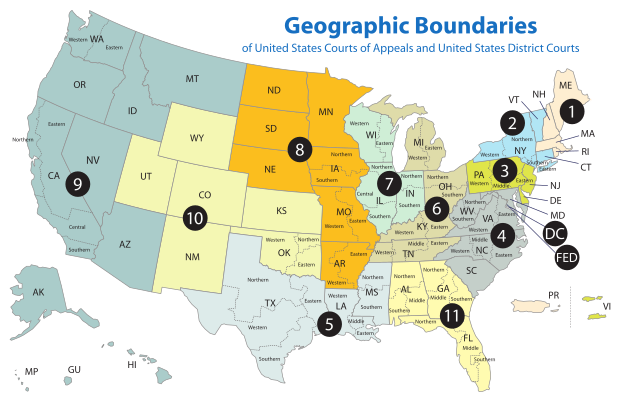
Why is it better for the NHL to take this action than to wait for the NHLPA to take action? Well, in large part, because of where the request was made. US courts are divided into geographical circuits, and different circuits, of course, are made up of different judges and may be likely to rule in different ways. The NHL filed for this declaration in New York, in the Second Circuit, which is known to be a little bit more league-friendly. Had they waited for the NHLPA to file a suit against them, they likely would have filed it in California, part of the more labor-friendly Ninth Circuit. Of course, this doesn't stop the PA from filing a suit in the Ninth Circuit, but it does mean that the first court to start to look at this will be the Second Circuit, which is good for the NHL.
Which actually brings us back to the whole decertification/disclaimer of interest thing. Part of the NHL's argument for the lockout's legality is that any disclaimer of interest filed by the NHLPA would very obviously be a negotiation tactic and not a meaningful dissolution. That argument would have been harder to make after a decertification, since that's a more in-depth process that requires a vote and involves the NLRB. It might be an easier argument to make after a disclaimer of interest, albeit one that also involved a player vote.
But wait! There's more! In addition to asking the courts for a declaration of the lockout's legality, the NHL also asked them for a ruling that, should the NHLPA dissolve, then all player contracts be rendered void. Let that sucker soak in for a minute. The argument goes like this: all player contracts were negotiated according to a very specific set of rules laid out in a collective bargaining agreement between the NHL and the NHLPA. If no NHLPA means no CBA, as discussed above, then shouldn't it also mean that the player contracts described by the CBA (which literally contains within it the "Standard Player Contract" on which all player contracts are based) are also void?
It's not as easy a sell as "the lockout is legal," but if they got it, it'd could be as huge a blow for them as getting the lockout declared illegal would be a blow against them.
Finally, on top of the 2-pronged lawsuit the NHL filed, the league also went to the NLRB (remember how I said you'd hear more about them? I never lie to you) and filed an Unfair Labor Practice Charge against the NHLPA, for what they consider "bad faith bargaining." The NHL is claiming that the NHLPA is threatening a disclaimer of interest without any real desire to dissolve the union, as a negotiation tactic. This could be considered by the NLRB to be an attempt to circumvent the actual collective bargaining process, which would be an illegal negotiation tactic. It's hard to say how the NLRB would come down here, but at the very least, the argument that the NHLPA is using this as a bargaining chip and has no real desire to dissolve is probably a pretty solid one.
Here's the good news (well, the not-as-bad news): there is precedent for this crazy legal cold war to still result in a season. Last season's NBA lockout (remember how nice it was when, not only was there hockey, but as a bonus, there also wasn't basketball?) saw a very similar series of events. All the way back on August 2, the NBA filed in New York to declare its brand new lockout legal, and they filed a complaint with the NLRB, declaring the NBPA uncooperative because the NBPA was threatening to dissolve its union. Then, on November 14, the NBPA actually did disclaim interest, thus dissolving, and sure enough, the next day, individual players filed antitrust suits against the NBA (in the Eighth and Ninth Circuits). Well, the thing is, 11 days later, the NBA and players came up with an agreement; 5 days after that, the NBPA re-formed; and a week after that, the new agreement was officially signed by the NBA and NBPA.
So, the point is: even going through exactly these same apocalyptic-looking steps, the NBA nonetheless settled and found a way to play a season. So there's precedent. But then, no other league really seems to have the same history of obvious animosity that the NHL does, does it? Regardless, we are where we are: the NHL has filed a suit to declare the lockout legal and to declare player contracts void if the NHLPA dissolves; the NHL has filed a complaint with the NLRB to declare that the NHLPA is illegally negotiating in bad faith; and the NHLPA's membership is in the middle of voting to authorize its leadership to file a disclaimer of interest.
And as of exactly one year ago, the NBA had played 4 preseason games.
Wednesday, December 5, 2012
Operation: Hat Trick
Last week, I did something that I expect I will remember for a long time. Everyone else has already written about it by now, but I have a day job and also I'm busy, so I'm writing about it now. Pick your favorite "Deal With It" meme and just imagine I put it here.
I find it hard to believe that you don't know what Operation: Hat Trick was, but just in case: Brad Richards and Scott Hartnell organized a charity game in Atlantic City, to benefit the Empire State Relief Fund and the New Jersey State Relief Fund, and they invited all their friends. And it turns out that they, and all their friends, are very good at hockey (rosters here), so a lot of people came and watched.
So 10,000 hockey fans descended on Atlantic City for what was Broadway Hall's first sellout game since 1933. Mostly Flyer fans, with a whole lot of Ranger fans - the makeup was pretty similar to the Winter Classic last season (was that only last season?). The atmosphere was all about hockey - this was a group of people whose home states had been totally ravaged by this storm, but it was immediately clear that these people were all here because their NHL season was gone. I chose not to wear a jersey, as I have been refusing to wear any NHL or team gear since the lockout began, but most attendees were in some kind of team apparel.
From the moment the doors opened, it was clear that everyone just wanted to be a hockey fan again. I've been to some pretty big hockey games before, but I've never been to one where the crowd outside roared like this when they saw the arena doors open. It was a night that united all fans in our desire to bring hockey back. But what struck me most was that it united us like hockey fans. It was this bizarre feeling whereby Flyer fans were screaming "Let's Go Flyers" and booing Brad Richards, and Ranger fans were shouting "Henrik" and calling Jody Shelley a bum, but -- it's hard to describe -- it felt like we were all rooting for the same team while we were doing it. It was like, "Hey NHL, look how badly we want to call each other assholes again; why won't you let us?"
As for the game itself, it was pretty much what you'd expect: the skaters all played like it was a charity game, Lundqvist was in mid-season form, and Brodeur outpaced Bernie Parent's performance in the Winter Classic Alumni Game. Top 3 chants by popularity: (1) "We want hockey" (2) "Fire Bettman" (3) "Maaaaartyyyyyy!" Honorable mention: "Crosby sucks" (he was neither in the building nor mentioned previously; some Flyer fans just wanted to make sure everyone remembered).
Old man goalie-bashing notwithstanding, it was a pretty great environment for everyone. Fans behind the benches were throwing stuff and markers over the boards, and players were signing and throwing them back. After the first period, a guy near me yelled at Kerry Fraser (did I mention that Kerry Fraser officiated this game?) "Hey Kerry, nice hair!" and Fraser turned around and gave us an Arthur Fonzarelli hair-touch-and-thumbs-up.
And the thing is: the players were having that much fun, too. It felt a little like the All-Star Game (in level of talent, as well). At some point in the third period, Bobby Ryan took a completely unreasonable dive to try to get at a puck that was way out of his reach, and when he found himself on the ice, he started using his stick to "kayak" his way to the boards. A few minutes later, Brian Boyle came in on Brodeur all alone in the slot, and his shot was saved high into the netting. Boyle circled with a grin on his face and put 2 arms in the air to indicate that his Field Goal kick was good (Canadian readers, that is an American football joke - don't worry about it). The players never stopped grinning the whole time.
And that's really the takeaway - for one night, the players and fans were able to come together and enjoy doing what they're supposed to do. It was clear that everyone involved in the event had a ball, and everyone just wanted to be able to continue doing their thing. Steven Stamkos wants a third chance at a breakaway on Lundqvist. Fans want to continue to tell Marty Brodeur how much he sucks. It was a night wherein, despite lockouts and weather, everyone was united in the only way we know how to be. We want hockey.
I find it hard to believe that you don't know what Operation: Hat Trick was, but just in case: Brad Richards and Scott Hartnell organized a charity game in Atlantic City, to benefit the Empire State Relief Fund and the New Jersey State Relief Fund, and they invited all their friends. And it turns out that they, and all their friends, are very good at hockey (rosters here), so a lot of people came and watched.
So 10,000 hockey fans descended on Atlantic City for what was Broadway Hall's first sellout game since 1933. Mostly Flyer fans, with a whole lot of Ranger fans - the makeup was pretty similar to the Winter Classic last season (was that only last season?). The atmosphere was all about hockey - this was a group of people whose home states had been totally ravaged by this storm, but it was immediately clear that these people were all here because their NHL season was gone. I chose not to wear a jersey, as I have been refusing to wear any NHL or team gear since the lockout began, but most attendees were in some kind of team apparel.
From the moment the doors opened, it was clear that everyone just wanted to be a hockey fan again. I've been to some pretty big hockey games before, but I've never been to one where the crowd outside roared like this when they saw the arena doors open. It was a night that united all fans in our desire to bring hockey back. But what struck me most was that it united us like hockey fans. It was this bizarre feeling whereby Flyer fans were screaming "Let's Go Flyers" and booing Brad Richards, and Ranger fans were shouting "Henrik" and calling Jody Shelley a bum, but -- it's hard to describe -- it felt like we were all rooting for the same team while we were doing it. It was like, "Hey NHL, look how badly we want to call each other assholes again; why won't you let us?"
As for the game itself, it was pretty much what you'd expect: the skaters all played like it was a charity game, Lundqvist was in mid-season form, and Brodeur outpaced Bernie Parent's performance in the Winter Classic Alumni Game. Top 3 chants by popularity: (1) "We want hockey" (2) "Fire Bettman" (3) "Maaaaartyyyyyy!" Honorable mention: "Crosby sucks" (he was neither in the building nor mentioned previously; some Flyer fans just wanted to make sure everyone remembered).
Old man goalie-bashing notwithstanding, it was a pretty great environment for everyone. Fans behind the benches were throwing stuff and markers over the boards, and players were signing and throwing them back. After the first period, a guy near me yelled at Kerry Fraser (did I mention that Kerry Fraser officiated this game?) "Hey Kerry, nice hair!" and Fraser turned around and gave us an Arthur Fonzarelli hair-touch-and-thumbs-up.
And the thing is: the players were having that much fun, too. It felt a little like the All-Star Game (in level of talent, as well). At some point in the third period, Bobby Ryan took a completely unreasonable dive to try to get at a puck that was way out of his reach, and when he found himself on the ice, he started using his stick to "kayak" his way to the boards. A few minutes later, Brian Boyle came in on Brodeur all alone in the slot, and his shot was saved high into the netting. Boyle circled with a grin on his face and put 2 arms in the air to indicate that his Field Goal kick was good (Canadian readers, that is an American football joke - don't worry about it). The players never stopped grinning the whole time.
And that's really the takeaway - for one night, the players and fans were able to come together and enjoy doing what they're supposed to do. It was clear that everyone involved in the event had a ball, and everyone just wanted to be able to continue doing their thing. Steven Stamkos wants a third chance at a breakaway on Lundqvist. Fans want to continue to tell Marty Brodeur how much he sucks. It was a night wherein, despite lockouts and weather, everyone was united in the only way we know how to be. We want hockey.
Subscribe to:
Posts (Atom)